You Recently Viewed...
  1. Railroad and Trucking Companies
  2. Fees for Published Reports, Services
  3. Bulletins and Security Levels
  4. Tug with Tows Safety Advisory
  5. Voluntary Air Quality Compliance Zone
Popular Articles
  1. Equipment and Systems
  2. TWITTER
  3. About the VTS
 
 »  Home  »  MARITIME INFORMATION  »  Maritime News  »  News Archive (Past Items)
News Archive (Past Items)
» California's Global Gateways: Trends and Issues
by Site Administrator | Published 04/19/2004 
 TO ALL INTERESTED PARTIES:

We are pleased to present herein a copy of the report produced by the Public Policy Institute of California (PPIC) entitled: "CALIFORNIA'S GLOBAL GATEWAYS: TRENDS AND ISSUES". This important "white paper" offers a detailed analysis of California's shipping activities, and its powerful role in providing "global gateways" for handling a substantial portion of America's international commerce. The document is lengthy (109 pages), but well worth the read for those who are concerned and involved with global trade -- and particularly for those who live and work in California, or who bring their goods through our ports.

In the report's "Forward" (written by David Lyon, CEO of PPIC), you'll note that he clearly describes therein the paradox that California now faces. And that is: while California's ports are experiencing unprecedented success and (in some cases) double-digit growth in accommodating the ever-expanding flow of world trade cargoes (bringing new jobs, new profits, and new tax revenues to the state) -- with that success and growth comes the negative "side effects" of massive freeway congestion, increased air pollution, and significant infrastructure wear-and-tear that is increasingly impacting the quality of life issues that most Californians hold dear. Add to that the real need to address homeland defense and port security issues in a profound and timely manner, and you have a challenge that seems daunting at best, and impossible at worst. As Mr. Lyons sums it up: .... "(the authors) make it abundantly clear that 'Global California' is finally inseparable from 'Local California', and that visionary solutions at this level can affect the state's competitive position in the world"....

Our thanks to Mr. Jim Haussner, Executive Secretary for the California Marine Affairs and Navigation Conference (C-MANC), for sharing this important document with us. 

Capt. Manny Aschemeyer, Executive Director

> Marine Exchange of Southern California

» VTS 2004 Presentation
by Site Administrator | Published 02/05/2004 
Partnership=Success: VTS For Los Angeles/Long Beach Harbor. Click HERE to read the "white paper" presented to the 2004 International VTS Symposium in Hong Kong, presented by Capt. Manny Aschemeyer.
» VTS Spotlighted in Professional Mariner Magazine
by Site Administrator | Published 06/06/2004 

PROFESSIONAL MARINER MAGAZINE ARTICLE:
VTS ALLOWS SoCAL PORTS TO HANDLE GROWTH SAFELY

Professional Mariner Magazine

COPYRIGHT NOTICE --

Posting of this article to www.MXSoCal.org is with permission from Professional Mariner Magazine. This article is protected under copyright laws and may not be reproduced or distributed from this web site without written permission from Professional Mariner Magazine. Contact John Gormley, Editor, at jgormley@professionalmariner.com.

--------------------------------------------------------------------

The neighboring ports of Los Angeles and Long Beach compete fiercely for business, but when it comes to moving ships in and out of San Pedro Bay safely, the two are eager collaborators.

Either one by itself would be the largest container port in the United States. Considered as a single transportation complex, which the two really are, they form the third-largest container port in the world, exceeded only by Hong Kong and Singapore.

Big as these ports are, they are getting bigger fast, thanks largely to the rapid expansion of the Chinese economy. Los Angeles and Long Beach are far and away the biggest beneficiaries of that boom, handling two-thirds of the Pacific Rim cargo containers moving through U.S. ports.

In 1990 the container traffic through the twin Southern California ports amounted to about 1 million TEUs (20-foot equivalent units). In 2003 the volume exceeded 11.8 million TEUs (4.6 million in Long Beach and 7.2 million in Los Angeles). Over the next decade that figure is expected to double again.

Sean Smith
Vessel traffic in Los Angeles and Long Beach is monitored both by active duty Coast Guard personnel, such as Petty Officer First Class Sean Smith (above) and by employees of the Marine Exchange, including watch supervisor Ray Law (below).
Ray Law

How have the two ports been able to handle such tremendous growth, while safely managing the vessel traf-fic? A good part of the answer is to be found at Point Fermin in the San Pedro section of Los Angeles. Here, at the crest of the hill offering breathtaking views of the harbor, Santa Catalina Island and the Pacific beyond, sits a bunker-like structure that once commanded a Nike missile base. This building is home to the Marine Exchange of Southern California, operator of the Vessel Traffic System for the ports of Long Beach and Los Angeles. The Marine Exchange, in cooperation with the U.S. Coast Guard and the two pilot groups in the ports, has created an unusual and highly successful model for safely controlling the movement of ships in and out of the harbor.

“Everybody’s a competitor here in getting the customers and contracts,” said Capt. Richard B. McKenna, the Marine Exchange’s deputy executive director. But the VTS, he explained, is “the product of the harbor community” and an expression of “how we cooperate in terms of the big picture.”

The VTS is in a literal sense the creator of the big picture. Its computer hardware and software process radar data and other information sources to create a comprehensive picture of ship movements from 25 miles out on the Pacific right up to the docks.

Technology plays a big role in fulfilling this task. At the heart of the VTS is an advanced PC-based system — a VOC 5060 operator workstation by Norcontrol IT that was installed in January 2002.

The system allows the Marine Exchange to distribute this big picture in real time to the groups in the port that need it — notably the pilots, to help them do their job of bringing ships in and out of the port safely, and the Coast Guard, to help it fulfill its safety, regulatory, rescue and security roles.

The system also allows the Marine Exchange to record all the information processed by the system. In effect, the Marine Exchange is creating a history of what every ship is doing at any given moment. Clearly this kind of record can be a powerful tool for enforcement of regulations and investigations of accidents. It can also be invaluable as a training tool.

In December 2003, the VTS capability was enhanced by the introduction of AIS (automatic identification system) technology. A new AIS shore station supplied by Tideland Maritime Systems allows the VTS computers to collect automatically a variety of data on ship movements that previously was obtained through radio calls and radar contacts. Because the AIS data has been integrated into the VTS, all this information is immediately displayed on the Marine Exchange website and can be viewed in real time by users throughout the port on their PCs. For security
reasons, only those who have gained clearance from the Marine Exchange can view this part of the website.

While the technology is a defining element of the system, it is not what sets it apart. What makes it perhaps unique in the nation is the cooperative arrangement with the Coast Guard. In other ports with VTS, the Coast Guard operates the system. In Los Angeles/Long Beach, the Marine Exchange, a private nonprofit organization has primary responsibility for the system, under authority delegated by the Coast Guard. While the system is housed in the Marine Exchange’s building, the job of actually monitoring and assisting vessels is shared by employees of the Marine Exchange and active duty Coast Guard personnel.

Under most circumstances, the VTS personnel simply provide information to the crews of ships to help them navigate safely. They alert them to the whereabouts and movements of nearby vessels or of traffic conditions or weather, such as patches of fog. Or they might warn them if they seem to be headed into a hazardous situation. They also notify vessels that are exceeding the speed limit of 12 knots or failing to maintain the minimum separation distance of a quarter mile.

While the personnel operating the VTS don’t ordinarily give direct commands to vessels, they have the authority to do so. Because of the cooperative arrangement with the Coast Guard, the VTS acts as the “direct representative of the captain of the port,” McKenna said. “I think we have used that authority maybe five times in a quarter-million ship movements.”

The VTS’s Coast Guard connection has other serious implications for the officers in charge of ships calling in Long Beach or Los Angeles: Rule violations or operational problems observed by VTS are reported to the Coast Guard for possible enforcement action.

“We have a high degree of compliance with the 12 knot speed limit,” McKenna said. “We make sure that everybody observes the rules.”

McKenna tells the story of one irate captain who showed up at the Marine Exchange with his lawyer after he was accused of a speeding violation. He arrived with charts under his arm, prepared to contest the allegations.

McKenna took the two men to show them what the new Norcontrol equipment could do, including the replay of the ship movements under discussion. That record left no question about what had happened. According to McKenna, the lawyer turned to his client and said, “I think we ought to thank both these gentlemen and leave.”

Not every observed violation results in a fine or formal charge. Sometimes the Coast Guard sends out a “letter of concern” based on what the VTS observed. This is a warning that does not go on the deck officer’s official record but still has consequences since a copy is sent to the employer. “That was invented here,” said Capt. M.H.K. “Manny” Aschemeyer, the Marine Exchange’s executive director, of the letter of concern. “When a company gets it, that’s heavy duty.”

Perhaps the best measure of the success of the cooperative approach to VTS is the fact that the L.A./Long Beach model has survived. When the system was launched as a hybrid operation, many thought the arrangement would be temporary and that the Coast Guard would eventually run the whole show.

The system was created following the Exxon Valdez oil spill in Alaska. In the aftermath, the state of California pushed hard for a system to prevent a similar disaster from occurring in one of its ports. But several years went by without the Coast Guard setting anything up in Southern California. Under mounting pressure from the state, the Coast Guard agreed to let the Marine Exchange lead the way.

“It was intended to be an interim setup,” McKenna said. “Washington looked on it as a threat for a while.”

There is a saying that few things are more permanent than the provisional. The Southern California VTS would seem to fall into that category. “We’re still a bit of an odd duck,” McKenna observed.

Odd duck or not, it seems to have a very loyal following in the two ports.

Michael Rubino
Traffic inside the breakwater is monitored by the two pilots' groups. Above, Capt. Michael R. Rubino, chief port pilot in Los Angeles, uses radar at his pilot station to assist a vessel through patchy fog.

The two pilot groups in particular have embraced it and have become integral parts of the overall system. The Marine Exchange VTS tracks vessels within 25 miles of the port but outside the breakwater at the entrance to the harbor. Once vessels pass inside the breakwater, they become the responsibility of the pilot groups.


“This is a partnership. We’re joined at the hip,” Aschemeyer said.

Jacobsen Pilot Services Inc. provides pilots in the Port of Long Beach. Capt. Thomas A. Jacobsen, president of the group, agreed that cooperation within the two port communities has been the recipe for success. “Everyone works together quite well,” he said.

Each of the pilot groups is linked to the VTS system and uses that information to help the pilots operate safely. The Long Beach pilots have taken a leadership role in developing even further the technology available to move ships safely in and out of the port.

With financial help from the Port of Long Beach, the Jacobsen pilots have been working on a DGPS-based system called PilotMate. The system integrates GPS data, electronic charts and the dimensions of specific ships. The pilot brings a GPS aboard, and then positions it at a location that is programmed into the computer. Since the computer has also been programmed with the dimensions of the ship, it can display a chart featuring an icon that locates the precise position of the vessel relative to other charted features.

In practice this means that the pilot can look at the screen and see, for example, exactly where the ship is in relation to the dock or the edge of the channel.

“You can tell how far off the bow is, how far off the stern is with an accuracy of less than 10 feet,” said Capt. Grant Livingstone, one of the Jacobsen pilots who helped to develop the system and demonstrate its capabilities.

Clearly this has enormous implications for handling large ships in a port as busy as Long Beach. And the implications become greater as each generation of containership increases in size.

The very fate of ports will depend on their ability to accommodate ships well in excess of 1,000 feet in length. Sometimes ships have to be turned in basins that are barely bigger than the ship is long.

PilotMate gives the pilots a way of determining with great confidence the exact position of the ship, allowing them to operate safely and efficiently within much closer tolerances. It also allows them to operate more confidently in conditions of lower visibility.

“It is a phenomenal system,” Livingstone said. “It really changed our capability of safe movement.”

While Livingstone is proud of the role his group has played in demonstrating the capabilities of PilotMate, he is acutely aware of the dangers of reliance on technology at the expense of good judgment and ship handling.

“We do not want technology to displace seamanship skills,” he said. “PilotMate is not the way we make our navigation decisions. PilotMate just confirms the decision.”

Technology, seamanship, cooperation. Those are the elements that have allowed Los Angeles and Long Beach to handle the great surge in traffic that the two ports are enjoying.

Aschemeyer thinks there are lessons other ports could learn from the example set by the Marine Exchange and its partners in Los Angeles and Long Beach. “We can be considered a national model for what can be done with a private/public model,” he said. “We have a navigational flow that is seamless from 25 miles out all the way to the dock.”

----------------------------------------------------------------------------------------

For subscription Information to Professional Mariner Magazine, click on
www.professionalmariner.com/site/subsc/sPrintUs.asp

For advertising information at Professional Mariner Magazine, click on
www.professionalmariner.com/site/advert/

Marine Exchange & VTS for LA/LB Harbor

» Who We Are
by Site Administrator | Published 08/05/2005 

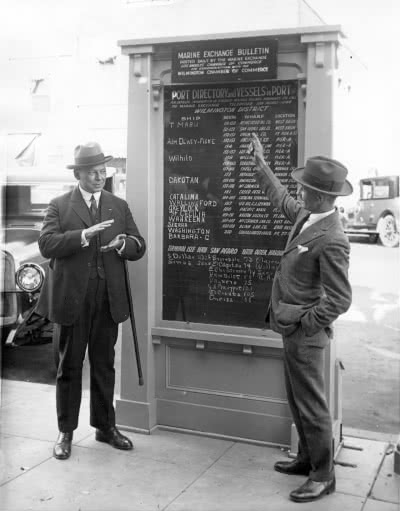
The Marine Exchange of Southern California is an eighty plus year old, non-profit organization dedicated to the development and efficient flow of maritime commerce throughout the region. Our records of ship arrivals and departures go back to 1923 in a string broken only by WW II. Since then, we have evolved into the Maritime Information Center for the Los Angeles - Long Beach Port Complex.

The icons to the left will take you to the various aspects of the Port Complex in which we play a role. Click on the icon that interests you to find the kinds of information described below.

We provide extensive reports of ship activities for the Ports of Los Angeles and Long Beach, as well as Port Hueneme to the north and San Diego to the south. Check our REPORTS section to find a variety of ship information reports on schedules, arrival times, locations, etc tailored to suit your needs.

We also are partners with the United States Coast Guard in running the only public-private partnership Vessel Traffic Service in the United States. Our VTS section will provide operating rules, important notices, user fees and, for those authorized, a real time picture of our vessel traffic situation.

The Marine Exchange acts as the Secretariat for our local Harbor Safety Committee. You’ll be able to find the latest Harbor Safety Plan for the Port Complex, as well as tug bollard pull information and recent safety notices by looking here. Check out our other icons to the left for important elements of information about our Ports. If you can’t find what you’re looking for, try our SITE MAP or give the search engine a try.

As the de facto ship operations center for Southern California, our goal is to provide the most up to date information available. We strive to keep you, our customers informed. We are open to suggestions on how we may improve our operation. Reach us HERE.