Popular Articles
  1. Equipment and Systems
  2. Vessel Traffic Updates (Graphs)
  3. About the VTS
 
 »  Home  »  Our History
Our History

A HISTORY OF THE MARINE EXCHANGE

From horseback runners and lookouts waving signal flags and using flashing signal lights -- to today’s highly professional MX-VTS technicians operating state-of-the-art electronic radar tracking equipment, radio communications and computer database functions -- the Marine Exchange of Southern California has evolved into one of the world’s foremost such organizations, becoming a world-class entity serving the ports of Los Angeles, Long Beach, El Segundo, San Diego and Port Hueneme as well as the maritime business communities throughout the Southern California region. And the “best” is yet to come as it moves forward with confidence into the 21st century.

The Early 1900s

In dramatic contrast to the now bustling, breakwater-protected harbor for the megaports of Los Angeles and Long Beach, San Pedro Bay in the early 1900s was nothing more than an open roadstead with sailing ships and steamships calling at a few privately owned piers and wharves.

To watch for arriving vessels, ship owners and their agents dispatched “runners” on horseback to lookout posts at Point Fermin seaward of San Pedro; or, to a lesser extent, to positions high atop Signal Hill above Long Beach.

These runners peered through binoculars or telescopes to identify sailing ships by their rigs or names, and steamships by their stack markings, as the ships made their final approaches into San Pedro Bay. After identifying arriving vessels, they rapidly rode the horses back to their offi ces to alert pilots, tugs, stevedores, terminals, government agencies and others. Later, when telephones came into use, arrival arrangements were handled over the closest phone. As ship arrivals increased, the Point Fermin and Signal Hill lookouts became congested with runners.

1920-1940

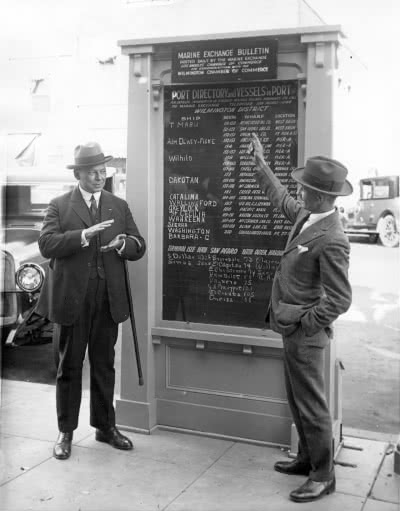
When the ports of Los Angeles and Long Beach were established, W.H. Wickersham, an enterprising steamship agent and customhouse broker, formed the Maritime Exchange and Sailing Club of the Port of Los Angeles. He then hired professional "lookouts" to replace the redundant and sometimes dangerous runner system. For a fee, Wickersham’s organization provided ship arrival information for the maritime industry. These professional "lookouts", many of whom were retired Navy or Coast Guard quartermasters and signalmen, stood watch atop the Port of Los Angeles’ newly built Warehouse 1 in the Outer Harbor. They were equipped with signal lights, fl ags, binoculars,  megaphones, telescopes and telephones so that they could communicate with arriving ships as well as alert people ashore. Wickersham’s operation proved very popular; however, it was not profitable. By 1923, Wickersham was ready to “pull the plug.”

The Los Angeles Area Chamber of Commerce recognized the value of this professional lookout service. With urging from the waterfront business community, the Chamber took over Wickersham’s operation and adopted the name Marine Exchange of Los Angeles. This began the 72-year relationship with the Chamber of Commerce and the evolution of the Marine Exchange of Los Angeles-Long Beach Harbor, Inc.

Except during World War II when the Coast Guard was in charge of port operations (1942-1945), the Marine Exchange has operated 24 hours a day, seven days a week, every day of the year. It has kept a detailed record of every vessel arrival/departure from 1923 to the present.

1940-1980

In 1946, the Marine Exchange was incorporated as a nonprofit trade organization under the name Marine Exchange of Los Angeles-Long Beach Harbor, in recognition of the Port of Long Beach as well as Port of Los Angeles. Also that year, a surge in inquiries for information on vessel activity led the Marine Exchange to launch the daily 3-Day Advance Arrival Report, the forerunner of today's immensely popular "Advance Arrival Raport" (which spans five or more days).  During succeeding decades, the Marine Exchange added a number of services and reports related to vessel movements and harbor acitivites -- all of which remain in demand to this day. Click HERE to see sample reports available online, 24/7, and in real-time.

The 1980s

Vessel Traffic Advisory Service (VTAS) was inaugurated in 1981 and was the forerunner of today’s Marine Exchange-operated Vessel Traffic Service (VTS), the nation’s only government/private sector VTS partnership operation. VTAS was an informal, non-regulated, voluntary system for monitoring ship traffic at LA/LB Harbor; and as such, it provided considerable enhancement to vessel navigation safety through participation in this USCG-endorsed program by the vast majority of vessels calling at LA/LB Harbor.

Driven by the need to enlarge and modernize the VTAS, the Marine Exchange moved in 1989 to its present site in Angel’s Gate Park, overlooking Point Fermin. The ports of Long Beach and Los Angeles helped finance construction of a building to house the Marine Exchange and its VTAS. The U.S. Coast Guard offered free use of land where the structure was built. The facility was equipped with modern radar and radios, banks of telephones and high-powered binoculars. Two additional vessel traffic services milestones were subsequently achieved by the Marine Exchange.

The 1990s

To meet new federal and state vessel safety regulations in a cost-effective manner, a unique Vessel Traffic Service (VTS) came on line March 1, 1994, which now serves America’s busiest intermodal seaport complex at Los Angeles-Long Beach Harbor. It monitors and facilitates the safe passage of all commercial vessel traffic in Southern California waters. The VTS was created to provide safe, reliable and efficient maritime transportation through the prevention of allisions, collisions and grounding, thereby protecting California’s fragile environment and limited resources. Click HERE to read "Partnership=Success: Our VTS Story"....

The VTS was established pursuant to state law and in partnership with the ports of Los Angeles and Long Beach, the U.S.Coast Guard, the California Office of Spill Prevention and Response (OSPR), the maritime industry, the two harbor pilot organizations,  and the waterfront business community. The Marine Exchange of Southern California operates this system as an agent of the State of California and in partnership with the U.S. Coast Guard. The VTS advises and coordinates commercial vessel traffic operating within the VTS’ Area of Responsibility (AOR), which includes all waters outside the federal breakwaters -- San Pedro Bay, Santa Monica Bay, Newport Bay and Santa Catalina Island — extending 25 nautical miles from Point Fermin. The VTS now facilitates and monitors about 27,000 vessel transits each year on deep sea commercial ships and local vessels passing through the AOR. 

VTS-LA/LB is America’s first (and only) joint-ventured government/private sector vessel traffic system operation. Its startup was fully funded without taxpayer money. Currently, the VTS is financially self-sufficient through the application of VTS User Fees -- which are mandated by state law and required by port tariff -- to cover the costs of ongoing operating expenses.  Click HERE to see a copy of our VTS Users Fee Schedule.  VTS User Fees originally paid fot the six uniformed U.S. Coast Guard personnel assigned to the VTS as vessel traffic specialists and who stand watch alongside the Marine Exchange’s civilian staff. The presence and participation of the “blue suiters” at the VTS provides for USCG "Captain-of-the-Port Authority" to enforce federal navigation and safety regulations as well as to enforce port security and homeland defense procedures and policies. In 1999 after a careful budget review, the USCG agreed to absorb the cost for providing the six billets to the VTS-LA/LB program, thus enhancing their “partnership participation” significantly.

The VTS also works to keep small recreational craft safe through a "passive users program" and hourly broadcasts on marine radio band VHF Channel 14 of all vessel locations in the AOR. MX-VTS staff frequently attend meetings of boating groups, marina organizations, and yacht clubs. making presentation on how the VTS-LA/LB syatem works, and how it can help them to operate more safety on Southern California's waterways. Commercial ships (power-driven, over 40 meters LOA) and other designated vessels are mandated to use the VTS system by law.  Click HERE to see a copy of our VTS Users Manual....

In 1995, a desire to serve its marine industry customer base more effectively and efficiently led the Board of Directors to establish the Marine Exchange as an independent, self-supporting, nonprofit organization.  Independence was accomplished in January 1996 when the Los Angeles Area Chamber of Commerce graciously complied with a request for the Marine Exchange to be released from its Chamber affiliate status. Thus ended the 72-year relationship the MX had with the LAACC, and which allowed it to operate freely on its own terms and conditions for the first time. 

In November 1997, the U.S. Congress declared VTS-LA/LB to be a “national model”, and Vice President Al Gore cited the Los Angeles/Long Beach VTS as being “An excellent example for others to study and emulate as we continue to work together to reinvent government for the future benefit of all Americans.”  The Marine Exchange and the U.S. Coast Guard’s Sector LA/LB received Vice President Gore’s 1997 NationalPerformance Review “Hammer Award” for the successful start-up and ongoing efficient operation of VTS-LA/LB

In 1999 the Marine Exchange completed an impressive building expansion program with help from its partnership members, nearly doubling the size of its Vessel Traffic Center facility to accommodate the new equipment and staffing added since 1994.

2000 and Beyond

In early 2002, the Marine Exchange completed a contract with NorControl (IT) for a substantial upgrade in their computerized, state-of-the-art vessel tracking system.  The Previous "VOC 5000" system -- which was mainly hard-coded and based on proprietory hardware --was replaced with the new VOC 5060 system (which is mainly software based, and run on PC units).  Click HERE to read more about the VOC 5060 system.  This contract agreement was reached after an extensive RFP and bidding process was conducted by the MX, which included VTS systems providers from England, France, Germany, Norway, and the USA.   NorControl ultimately won the RFP drill based on their superior equipment and systems reliability, their ongoing maintgenance programs, and their system upgrades & training offered as part of their "package.   

We also added new radars to the suite of equipment at our VTS, which allows us to "see" better than ever before as we scan the horizon for approaching vessels.  After a detailed search, we decided on the Sperry Marine "BridgeMaster Radar units for our use in the VTS.  Click HERE to read about our new radars.  This new state-of-the-art equipment and displays greatly enhanced the VTS with greater ability to capture and track vessel targets throughout the AOR.-- and also opened the opportunity for adding new technology along the way (like AIS and ASVTS).   Click HERE to read the full story on the "upgrade project"....

On January 17, 2003, the Marine Exchange of Los Angeles/Long Beach Harbor, Inc. became  THE MARINE EXCHANGE OF SOUTHERN CALIFORNIA,” following unanimous approval from the Marine Exchange Board of Directors -- and with endorsement from port authorities, government agencies, constituents, partners, and the maritime business community we serves throughout the Southern California Region. The new name reflects the work and presence of the organization in its ongoing outreach to the ports and maritime community throughout the region. With the new name came new opportunities, features, reports and on-line services covering vessel traffic activity and statistics for all four major ports in Southern California.

“For those we’ve traditionally served in the Los Angeles-Long Beach harbor area, you’ll continue to see the same excellent service, attention, focus, and reports we’ve been providing our constituents for more than 80 years,” Executive Director Capt. M.H.K. "Manny" Aschemeyer said. “For folks operating elsewhere in the region – the ports of San Diego, El Segundo, and Port Hueneme — you’ll soon see a new presence as we reach out to meet your needs and assist you and your businesses in those areas.”

Also in 2003, the Marine Exchange awarded Tideland Maritime Systems (TMS) the contract to supply an AIS Shore Station as an additional information and security system for the jointly operated Marine Exchange – USCG Vessel Traffic System (VTS-LA/LB) located at the entrance to the ports of Los Angeles and Long Beach in San Pedro, California. The AIS equipment was installed in December 2003 and went on line in January 2004.  Automatic Identification System (AIS) is a vessel- and shore-based “transponder” system originally invented to aid ocean-going SOLAS vessels in collision avoidance. A vessel outfi tted with AIS will automatically and continuously transmit and receive critical static and dynamic data, such as vessel name, call sign, position, course, and  speed via two internationally designated VHF frequencies. This vessel-specific data is processed both onboard and onshore to give a navigator,VTS operator, or coastal authority real time information on surrounding vessel movements and to raise an alarm when a collision is predicted or a security parameter is breached. The International Maritime Organization (IMO) has mandated AIS as a safety and navigation aid for commercial vessels on international voyages. The U.S. Department of Homeland Security will require AIS as a monitoring device for most commercial vessels operating within US territorial waters. The AIS Shore Station supplied by TMS is manufactured to meet the IMO recommendations for AIS Shore Stations as developed by the International Association of Lighthouse Authorities (IALA).   More recently, Tidelands has contracted with the MX, the USCG, the USN, NOAA, and other agencies, to install yet another AIS "base station" on Santa Criz Island -- which will be "networked" back into the VTS at San Pedro -- and which will ultimately give us expanded covered out to Point Conception, Port Hueneme, and the entire Santa Barbara Channel TSS..  Click HERE to read more about the instrallation of AIS at the MX-VTS.... 

In 2004 the Marine Exchange announced its new “Target Mapping” program for use here in Southern California. By subscribing to this new service, customers gain 24/7 real-time access to a VTS display of vessels moving to/from LA/LB Harbor, as well as their locations in port, through the MX-PortSource Web site -- (Click HERE to see web site page for Target Mapping Program). Anyone interested in this new service should contact Capt. Dick McKenna at the Marine Exchange (phone: 310-519-3126; e-mail: rbm@mxsocal.org).

In 2005, the Marine Exchange introduced a newly revised and enhanced Web site -- "Marine Exchange/PortSource"   It is being enhanced almost every week to include even more features, services,and information to cover the entire Southern California maritime industry and waterfront business community.  And our various reports can now be purchased online, in real time, 24 hours a day!  Click HERE to sign up for this extraordinary service and to see "sample reports"!  Already our "new and improved" web site has become the most respected, most valued, and most used maritime information resource for the Southern California region. 

Today, the Marine Exchange is governed by a 15-member board of directors, who represent a wide spectrum of constituencies throughout the maritime industry. (Click HERE to see BOD Roster). We presently have a staff of 20 full-time employees, and 7 VTS-assigned USCG uniformed personnel. Click HERE to see MX-Staff Listings).

The Marine Exchange maintains a continuous 24-hour service, and utilizes a state-of-the-art, comprehensive, computerized database system to provide vital statistics and information on ships calling at all four major ports in Southern California: Hueneme, Los Angeles, Long Beach, and San Diego.  More than 300 subscribers are provided with various data and reports -- all delivered in a timely, accurate and professional way.  Click HERE to see our Tariif with details on all reports and services and fees for each....

Our subscribers (or "Business Partners" as we like to call them) receive detailed data via daily reports that list vessels’ ETA, ETD, size, tonnage, cargo class & type, destination, origination, owner, flag, operator, agent, assigned berth/anchorage, purpose of call, Lloyd’s data and other important information. Specific reports provided by the Marine Exchange include Advance Arrivals Report; Daily Logs for Actual Arrivals, Departures, & Shifts; Active Vessels in Port; Sailing and Shifting Sheet; Monthly Composites, and specialized "ad hoc reports" produced on demand according to customers’ needs and requirements. This has earned the Marine Exchange the reputation for being the "Honest Broker" in collecting, compiling and disseminating maritime information – and it is now highly regarded as the "Trusted Maritime Information Clearinghouse" for providing services and reports to the waterfront business community throughout Southern California, and elsewhere in the U.S.A., as well as overseas. Click HERE to see our Tariff Pages, with a detailed listing of all services and reports offered by the MX, along with a fee schedule for each. 

The Marine Exchange of Southern California welcomes feedback and suggestions as to how, when, where, and at what level it can assist businesses on the waterfront to function more effectively and efficiently as it provides timely, accurate, and reliable information needed each day.  We welcome your comments, opinions, and suggestions.